How to run farm payroll in Guatemala
Minimum wage by economic region, Bono 14, aguinaldo, IGSS? Learn how Guatemalan farm payroll is built, with 2026 figures and a worked example in quetzales.
- By Aragro Team
- Published
- Updated
- 7 min read
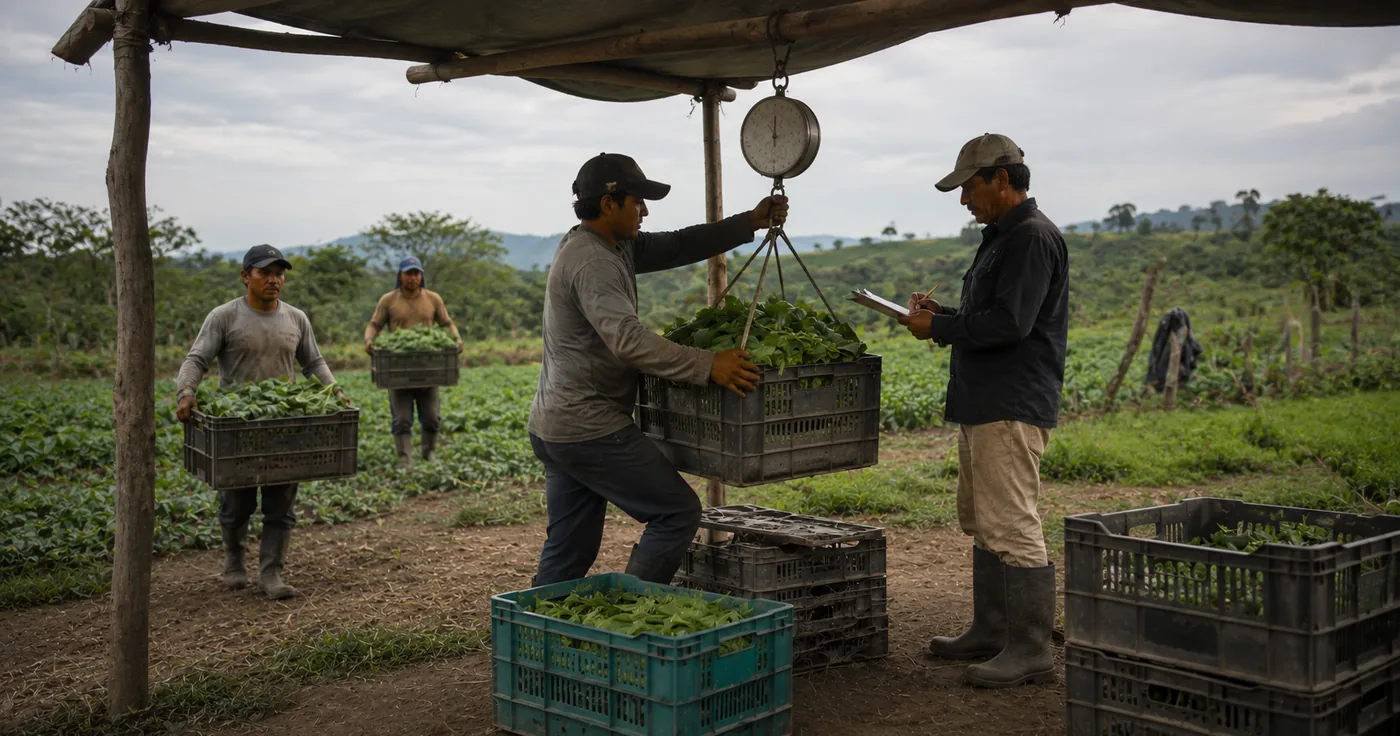
Farm payroll in Guatemala starts from recorded work, day wages, piecework or monthly salaries, and applies the current agricultural minimum wage, the statutory incentive bonus, two annual bonuses (Bono 14 and aguinaldo) and IGSS social-security contributions. This guide collects the 2026 figures with their legal sources; how to run farm payroll covers the general recording and settlement workflow.
Three institutions govern those figures. The Ministry of Labor and Social Welfare (MINTRAB) sets the minimum wage by government accord and authorizes the wage book. The Guatemalan Social Security Institute (IGSS) registers employers, receives the monthly payroll filing and collects social-security contributions, including the amounts it passes on to IRTRA and INTECAP. The Tax Administration Superintendency (SAT) administers income-tax (ISR) withholding on salary.
This is general guidance with figures current at publication, not legal, tax or accounting advice. Rules change, including the minimum wage each year; confirm every figure with the Ministry of Labor, IGSS or a Guatemalan accountant before applying it.
The 2026 agricultural minimum wage
The government published Acuerdo Gubernativo 256-2025 on December 22, 2025; it took effect on January 1, 2026 and sets the minimum wage by activity and economic circumscription:
| Agricultural activity, 2026 | Daily | Monthly |
|---|---|---|
| Economic Circumscription 1 (Guatemala department) | Q124.64 | Q3,791.20 |
| Economic Circumscription 2 (rest of the country) | Q119.21 | Q3,625.89 |
The circumscription follows where the work happens, not where the company registers. These amounts exclude the incentive bonus, which employers pay on top. The government usually publishes the next calendar year's accord in December, effective January 1: check for it before budgeting payroll.
The incentive bonus: Q250 per month
Every private-sector worker receives a Q250 monthly incentive bonus alongside the salary. Decreto 78-89 created the bonus and Decreto 37-2001, article 1, fixed the amount.
Article 2 of Decreto 78-89 keeps it out of almost every calculation base: the incentive bonus carries no employer or worker contributions to IGSS, IRTRA or INTECAP, and it does not raise the salary used for severance or aguinaldo, except when computing the seventh day. Record it as its own payslip line, separate from ordinary salary, so every base stays visible and auditable.
Bono 14 and aguinaldo: two extra salaries a year
The two annual statutory bonuses each equal 100% of one month's ordinary salary:
| Bonus | Legal basis | Calculation | Payment |
|---|---|---|---|
| Bono 14 | Decreto 42-92 | Average ordinary salary of the year ending in June | First half of July |
| Aguinaldo | Decreto 76-78 | One month's ordinary salary for a year of continuous service, proportional if shorter | 50% in early December, 50% in late January (or 100% in December) |
Employers pay both proportionally when the employment relationship runs shorter than a year. Aguinaldo carries no IGSS, IRTRA or INTECAP contributions (Decreto 76-78, article 15), and the same exemption extends to Bono 14 through the supplementary-application rule in Decreto 42-92, article 5; confirm the treatment with IGSS. For field workers on intermittent contracts, the aguinaldo law sets its own threshold: 150 worked days or tasks in the year earn the benefit (Decreto 76-78, article 10).
IGSS, IRTRA and INTECAP
Ordinary salary carries four contributions, and only one of them comes out of the worker's pay:
| Contribution | Rate | Who pays it |
|---|---|---|
| IGSS worker quota | 4.83% | The farm withholds it from each payment |
| IGSS employer quota | 10.67% | The farm, with no deduction from the worker |
| IRTRA (Decreto 1528, article 12) | 1% | The farm |
| INTECAP (Decreto 17-72, article 28) | up to 1% | The farm |
Employers pay IRTRA and INTECAP together with the employer quota, and IGSS passes each amount on to the corresponding institute. Two agricultural details matter here. The INTECAP organic law applies the rate only to permanent workers and exempts agricultural businesses with fewer than 10 permanent workers (article 28, paragraph 2). And since January 2023, Acuerdo 1529 of the IGSS board requires employer registration from the first worker, not from three as before. Confirm current rates, bases and coverage with IGSS before configuring payroll.
Income-tax (ISR) withholding follows SAT rules and depends on each worker's annual income. Decreto 13-2026, approved in April 2026, created an extraordinary deduction of Q3,024 that applies to fiscal year 2026 only; the new deduction equal to 12 non-agricultural monthly minimum wages including the incentive bonus takes effect on January 1, 2027. Confirm current values with SAT before calculating any withholding.
Labor-code rules that shape farm payroll
The labor code (Decreto 1441) adds rules payroll must reflect:
- Working time: an agricultural worker's ordinary daytime week runs 48 effective hours (article 116), except on farms employing 500 or more workers, where the general 45-hour rule applies; overtime carries at least a 50% premium (article 121), and the daily total may not exceed 12 hours (article 122).
- The seventh day: the weekly rest day earns pay, and workers on piece rate also earn an extra one sixth of the week's total (article 126). Article 88 recognizes piecework as payment by unit of work; piece-rate pay in agriculture covers how to set rates and record units.
- Records and frequency: from 3 to 9 permanent workers, a farm keeps payroll sheets following IGSS models; from 10 onward, a wage book authorized by the Ministry of Labor (article 102). Manual workers collect their pay at least every fortnight (article 92).
- Vacations: 15 paid working days after each continuous year; a worker whose contract does not require full hours or all days must reach at least 150 days worked in the year, and an agricultural or livestock business calculates the pay on the average of the last 3 months (articles 130, 131 and 134).
Worked example: one month in quetzales
A permanent agricultural worker in CE2, full month, no overtime and no ISR withholding, on a farm with 10 or more permanent workers:
| Line | Calculation | Value |
|---|---|---|
| Ordinary monthly salary | CE2 agricultural minimum | Q3,625.89 |
| Incentive bonus | Decreto 78-89 | Q250.00 |
| Total earned | 3,625.89 + 250 | Q3,875.89 |
| IGSS worker quota (4.83%) | 3,625.89 × 0.0483 | −Q175.13 |
| Net pay to the worker | 3,875.89 − 175.13 | Q3,700.76 |
| IGSS employer quota (10.67%) | 3,625.89 × 0.1067 | Q386.88 |
| IRTRA (1%) and INTECAP (1%) | 3,625.89 × 0.02 | Q72.52 |
| Bono 14 accrual (1/12) | 3,625.89 ÷ 12 | Q302.16 |
| Aguinaldo accrual (1/12) | 3,625.89 ÷ 12 | Q302.16 |
| Monthly cost to the farm | 3,875.89 + 386.88 + 72.52 + 604.32 | Q4,939.61 |
The example makes one point: the farm spends 27% more than the total-earned line shows. The annual bonuses account for Q604.32 a month of that gap and the employer contributions for another Q459.40. Neither reaches the worker's pocket that month, yet both are real cost of the field where the work happened. The example omits overtime, vacations, severance and any collective agreement; the Bono 14 and aguinaldo accruals are an accounting practice to spread the cost, not a monthly payment to the worker. Verify rates and bases with IGSS and SAT before applying it.
How this works in Aragro
Aragro builds Guatemalan payroll from the daily record. Work orders capture day wages, piecework units and attendance by field and activity, at the rates agreed at the time. In salary structures you define your payroll's Guatemalan components, each with its formula and base: ordinary salary, the incentive bonus kept out of the contribution base, the IGSS worker-quota deduction, and the Bono 14 and aguinaldo accruals. The payroll run fills the structure's employees with completed work for the period, calculates every component and stays open for your review; closing it sends labor cost to the cost centers of the fields worked.
Aragro does not file with IGSS or SAT, does not pay workers, and does not guarantee legal compliance. It calculates and documents so your accountant can review and your own process can pay. You configure the legal figures (minimums, percentages) and update them when December brings the next year's accord. Payroll and piecework availability depends on the plan.
If you operate in Guatemala, see Aragro for Guatemala and plans and pricing, and validate your component configuration with your accountant before the first run.
Frequently asked questions
What is the agricultural minimum wage in Guatemala in 2026?
Q124.64 per day (Q3,791.20 monthly) in Economic Circumscription 1, the Guatemala department, and Q119.21 per day (Q3,625.89 monthly) in CE2, the rest of the country, plus a Q250 monthly incentive bonus. Acuerdo Gubernativo 256-2025 sets these amounts, effective January 1, 2026.
What are Bono 14 and aguinaldo?
Two mandatory annual bonuses, each equal to one month's ordinary salary. Employers pay Bono 14 (Decreto 42-92) in the first half of July, on the average salary of the year ending in June; aguinaldo (Decreto 76-78) goes half in December and half in January, or fully in December.
Do seasonal harvest workers get aguinaldo and Bono 14?
It depends on time worked: under a year of service they receive the proportional part, and for field workers on intermittent contracts the aguinaldo law requires at least 150 worked days or tasks in the year (Decreto 76-78, article 10). Confirm the exact calculation with a Guatemalan accountant.
How do IGSS contributions work on farm payroll?
Ordinary salary carries two separate quotas: a 4.83% worker quota, which the farm withholds from each payment, and a 10.67% employer quota, which the farm pays on top and never deducts from the worker. On the same payroll the farm also files 1% IRTRA and up to 1% INTECAP, both employer-only. Confirm current rates and bases directly with IGSS.
What payroll records must a Guatemalan farm keep?
From 3 to 9 permanent workers, a farm keeps payroll sheets following IGSS models; from 10 onward, a wage book authorized by the Ministry of Labor (labor code, article 102). Manual workers must collect their pay at least every fortnight.
Can Aragro calculate Guatemalan farm payroll?
Yes: Aragro turns recorded work (day wages, piecework, salaries) and the salary structures you configure (incentive bonus, IGSS, Bono 14, aguinaldo) into a reviewable payroll run. Aragro does not file with IGSS or SAT and does not guarantee legal compliance.