How to run farm payroll
Still rebuilding payroll from attendance sheets and scattered notes? Learn how to turn recorded farm work into clear pay calculations and traceable labor costs.
- By Aragro Team
- Published
- Updated
- 8 min read
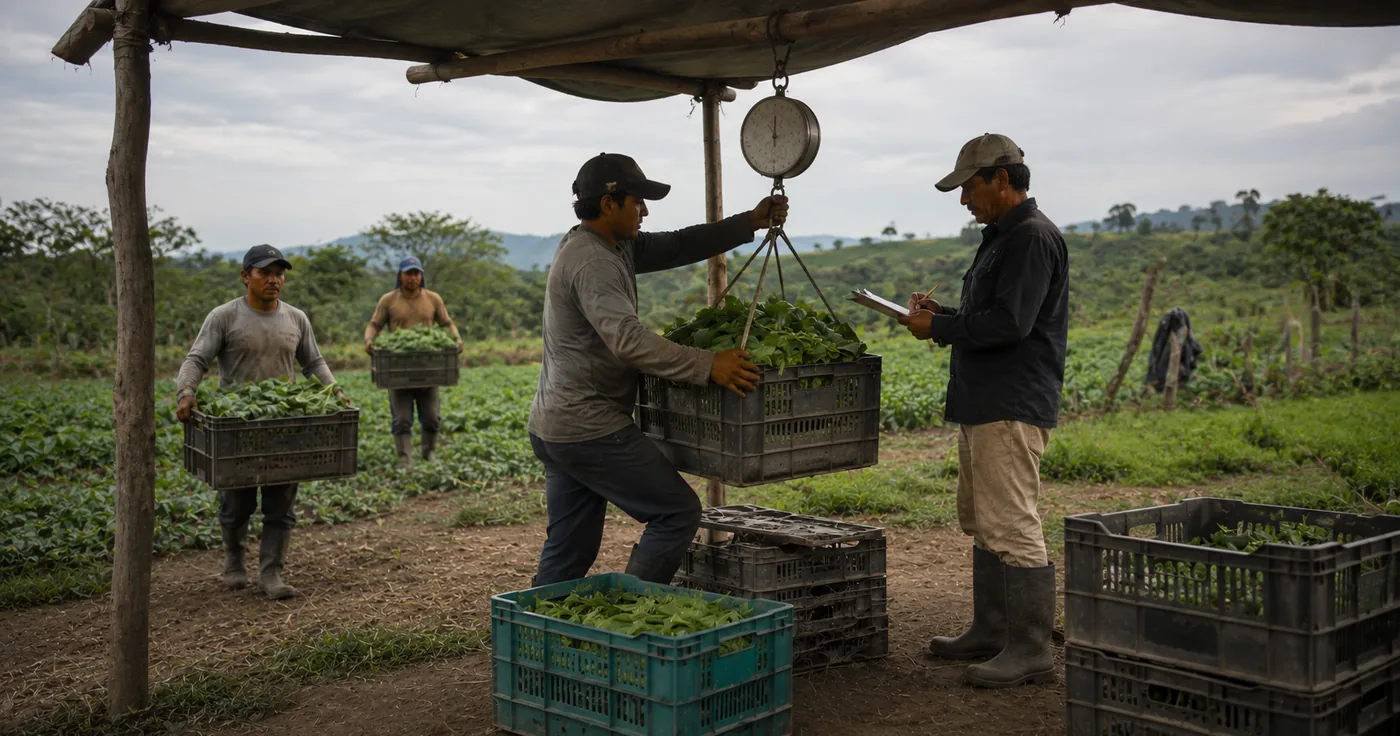
Farm payroll calculates and pays what workers earned for a period: time or completed work, applicable bonuses and lawful deductions. It also establishes the farm's labor cost. Because it is recurring and regulated, record the work as it happens rather than rebuilding it from memory at month-end.
This is general guidance, not legal, tax or accounting advice. Payroll requirements vary by country and change over time; confirm current local rules with the labor authority or an accountant.
Pay models, formulas and example
A farm may combine three pay models: day rate (jornal) for each day worked, piece rate (destajo) for each agreed unit completed, and a monthly salary for a fixed period, usually for permanent staff. Overtime, premiums and contractual or statutory bonuses may apply to any model.
Gross pay = units worked × rate + bonuses
Net pay = gross pay − deductions
For a day rate, units are days; for piece rate, they are boxes picked, rows weeded or other agreed units; for salary, they are the pay period. What comes off the worker's wage and what the farm pays on top of it are separated further down.
All three models share a legal floor. The ILO defines a minimum wage as "the minimum amount of remuneration that an employer is required to pay wage earners for the work performed during a given period, which cannot be reduced by collective agreement or an individual contract" (ILO, How to define a minimum wage?). Piece rate does not remove that floor: the ILO notes that in various countries "the legislation stipulates that pieceworkers' wages may not be lower than the applicable minimum wage", and the employer covers the gap (ILO, Piece rate pay). Setting the rate per unit is covered in piece-rate pay in agriculture.
| Line | Value |
|---|---|
| Days worked | 24 |
| Daily rate | 100 |
| Bonuses | 250 |
| Gross pay | 24 × 100 + 250 = 2,650 |
| Worker deductions | 120 |
| Net pay (what the worker receives) | 2,650 − 120 = 2,530 |
| Employer contributions | 300 |
| Total cost to the farm | 2,650 + 300 = 2,950 |
The deduction and contribution figures are illustrative: local law sets their rates. For piece rate, replace days worked × daily rate with units completed × agreed price per unit.
What data each run needs
A payroll run is only as accurate as the records feeding it:
| Input | Source | What it drives |
|---|---|---|
| Worker classification and terms | Registration or contract | Which rules and contributions apply |
| Pay model and agreed rate | Contract or task agreement | Gross pay, and a reproducible calculation |
| Days worked and absences | Daily attendance | Day wages and absence deductions |
| Accepted units per worker | Count at the work point | Piece-rate pay |
| Overtime and premiums | Working-time record | Overtime paid at the local premium |
| Field and activity | Work order | Labor cost landing on the right field |
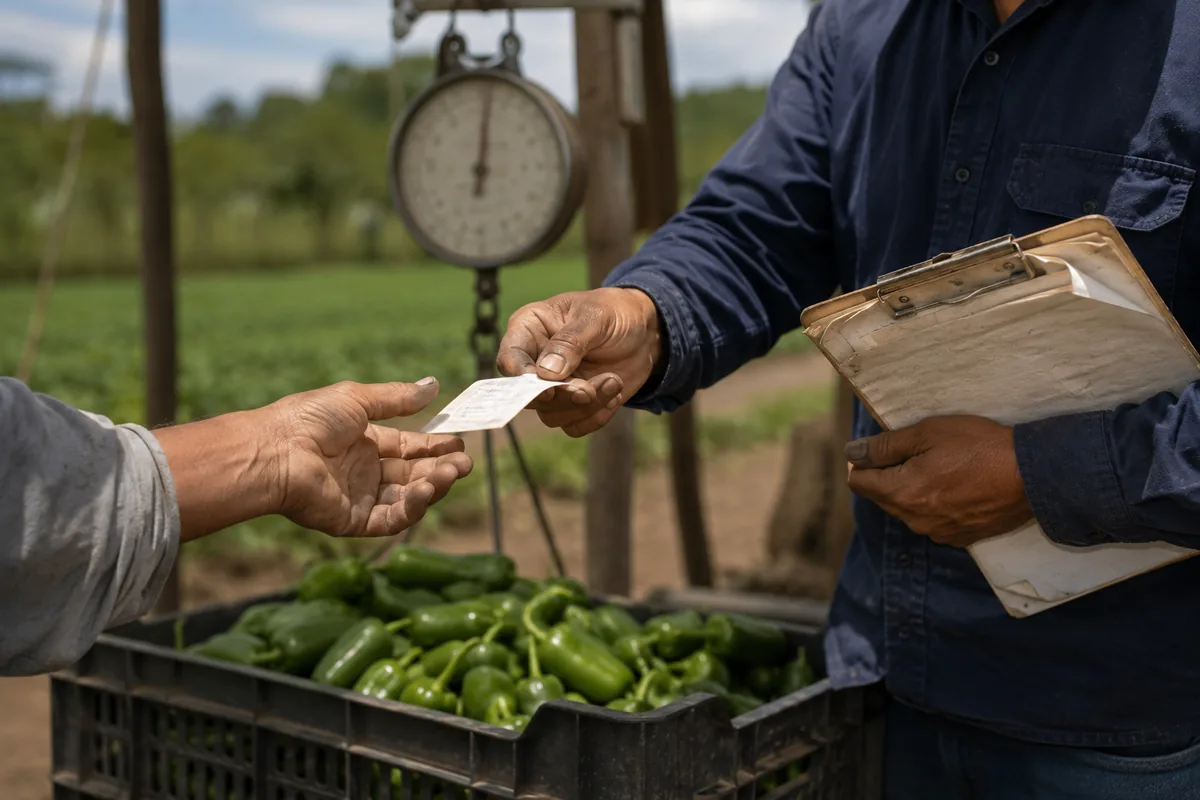
An input that does not exist on the day of work gets rebuilt from memory on payroll day, and that is where disputes start.
A checkable payroll workflow
- Set terms before work starts. Record each worker's classification, pay model and agreed rate. Agree piece rates contemporaneously, not after the output is known.
- Record the work when it happens. Capture day wages, accepted units, absences and overtime at the work point, linked to the field and activity.
- Close and calculate the period. Apply rates, bonuses and applicable overtime, then separate worker deductions from employer contributions.
- Review before payment. Check new workers, terminations, unusual totals, manual adjustments and the evidence behind them.
- Pay, give a clear statement and retain records. Keep them for the locally required period: they settle a dispute and show the real cost of a crew against the harvest estimate.
Have the worker and crew leader resolve a questioned tally or rate while the work is fresh. A payroll run is not the place to change a rate or an agreed deduction without notice.
Worker deductions and employer contributions
Gross pay splits into three destinations a payslip should never blur:
- What the worker receives: net pay, in cash or by transfer.
- What the employer withholds from the wage: the worker's social-security share, tax withholding where it applies, agreed advances and loans, and other authorized deductions.
- What the farm pays on top of the wage: the employer social-security quota, contributions to funds or institutes, and payroll taxes.
Only the second group reduces net pay: shifting an employer charge onto the worker underpays the wage. The Protection of Wages Convention, 1949 (ILO, No. 95) permits deductions "only under conditions and to the extent prescribed by national laws or regulations or fixed by collective agreement or arbitration award" (article 8), and asks employers to tell workers those conditions and give them, at each payment, "the particulars of their wages for the pay period concerned" (article 14). The practical rule: no deduction should ever appear for the first time on a payslip.
From net pay to the real cost of labor
Labor cost is what the employer spends to employ work, not what the worker takes home.
Labor cost = gross pay + employer contributions + benefit accruals + other employer charges
The international classification of labour cost, adopted by the Eleventh International Conference of Labour Statisticians in 1966, groups that spending into direct wages, remuneration for time not worked (vacation, holidays, severance), bonuses, payments in kind, housing, employers' social security expenditure, training, welfare services and taxes regarded as labour cost (ILO, Resolution concerning statistics of labour cost). That list doubles as an inventory of the lines farms forget when they budget a crew.
For planning, also split the fixed payroll from the variable one. FAO's farm-management extension guide treats payment for permanent labour as a fixed cost, and labour hired for tasks such as weeding and harvesting as a variable cost that rises with the area worked and with the yield (FAO, Economics for market-oriented farming, 2008). The full cost, not net pay, is what you allocate to the field: how it accumulates is covered in how to calculate production cost per field.
Local rules to verify
Before the first run, verify current local rules for:
- worker classification
- minimum wage
- working-time and overtime rules
- statutory bonuses
- social-security registration, rates and bases
- income-tax withholding
- payslip and payment requirements
- record retention
- termination, seasonal-worker and migrant-worker rules
Keep the confirmed rules with the rates you use, so a legal change can be traced to the affected payroll line. Operating in Guatemala? See how to run farm payroll in Guatemala for the 2026 figures.
Mistakes that break farm payroll
| Mistake | Consequence | Fix |
|---|---|---|
| Rebuilding attendance at month-end | Inaccurate pay and disputes with no evidence | Record attendance and units the same day |
| Treating net pay as labor cost | Short budgets and unreal margins per field | Add employer contributions and accruals |
| Charging an employer cost to the worker | An underpaid wage and legal exposure | Keep deductions and contributions on separate lines |
| Closing the period with work orders still open | Costs landing in the wrong cycle | Complete the operational record before calculating |
Payroll in Aragro
Aragro connects employee records to payroll calculation in the web app. Employees hold positions, wage terms and salary structures. Activities and work orders record who worked on what, and activity payments can be configured for piecework. From completed work records and configured salary structures, Payroll calculates a run for you to review and complete. Once work orders and payroll are complete, labor cost reaches the linked cost centers, fields and activities.

Aragro calculates and documents; it does not execute the payment or comply on your behalf: it does not move money, does not file with social-security or tax authorities, and does not guarantee statutory compliance. You can preview and print a payslip, but confirm that delivery and archiving meet local requirements. Attendance by day and activity and the salary book come with the Cultivo plan; basic payroll and piecework wages with Cosecha; advanced payroll with statutory benefits is a conversation with sales.
Configure positions, wage terms and salary structures, then record work against fields and activities. If payroll lives in Excel or an installed system today, when it pays to switch reviews the thresholds and the module-by-module migration. Planilla and Empleados are Spanish product guides. See the product overview and plans and pricing for availability.
Frequently asked questions
How do you calculate a day wage or piece rate?
For a day wage, multiply days worked by the agreed daily rate and add bonuses; for piece rate, use completed units × agreed price per unit. Subtract lawful deductions from gross pay to get net pay.
What data do you need to run farm payroll?
Each worker's classification and terms, the pay model and agreed rate, days worked and absences, accepted piece-rate units, overtime, bonuses, deductions for the period, and the field or activity where the work happened. Without those records captured on the day of work, the run gets rebuilt from memory.
What is the difference between net pay and labor cost?
Net pay is what the worker receives after deductions. Labor cost is gross pay plus employer contributions and other employer-side charges, so it is the figure to budget and allocate.
What can an employer deduct from a farm worker's wages?
Only what the applicable local rule permits or what the parties agreed in writing, such as the worker's social-security share, income-tax withholding where it applies, and advances or loans already agreed. ILO Convention 95 limits deductions to the conditions set by national law, a collective agreement or an arbitration award, and asks that workers be told those conditions.
How do you pay seasonal harvest workers?
With the same day-wage or piece-rate formulas, but with their own registration, classification and a rate agreed before work starts. Their entitlements and the contributions due depend on local law and time worked, so confirm both before the first run.
What legal payroll requirements apply to small farms?
Requirements depend on country and worker classification, including for small and seasonal farms. Confirm current minimum wage, registration, deductions, tax, payslip, retention and termination rules with the local authority or an accountant.
Can Aragro calculate farm payroll?
Yes: Aragro turns recorded work and the salary structures you configure into a reviewable payroll run, and carries the labor cost to the field's cost center. Aragro does not pay workers, does not file with social-security or tax authorities, and does not guarantee legal compliance.