How to control field operations
Control every field task from planning through its crew, inputs and actual cost.
- By Aragro Team
- Published
- 7 min read
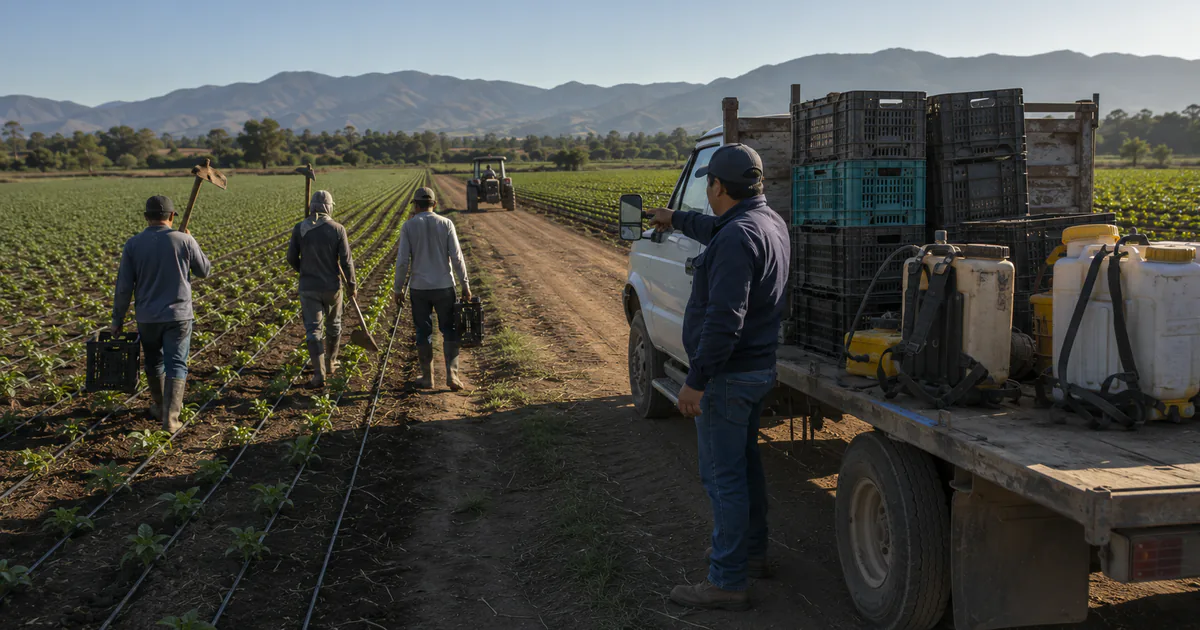
Controlling field operations means closing the loop between the plan and the work actually done: every task carries an owner, a crew, authorized inputs and an actual cost known when it closes, not months later. The instrument that holds that loop together is the work order.
Why do farms lose control of field tasks?
The pattern repeats on farms of every size: the supervisor hands out the day's tasks verbally in the morning, inputs leave the warehouse with a scribbled note or none, and nobody records how many people worked on which field. The consequences arrive in pieces: someone rebuilds payroll from memory, the warehouse never reconciles against what the crew applied, and cost per field, if anyone calculates it at all, arrives when no decision can change it.
The FAO handbook on agricultural cost of production statistics (2016) describes where that gap leads. When a farm does not record how much labor went into each task, labor cost no longer maps directly onto the tasks, and the farm has to spread it with allocation keys instead. Spreading it is estimating it. The problem is not lack of effort but lack of a unit of control: something connecting the plan, the execution and the cost of one same task.
The control cycle in six steps
- Plan the task with a budget. Which activity, on which fields, in which date window, at what expected cost of labor, inputs and machinery.
- Issue the work order. Turn the plan into a document with an owner: the task now exists, has a number, and someone answers for it.
- Assign crew, machinery and inputs. The order names the workers and machines; the crew requests inputs from the warehouse against that order, with dose or quantity per field.
- Execute and record the same day. Crew attendance, progress or piecework units per worker, machine hours and real consumption per field.
- Return and close. Unused product goes back to the warehouse on the record; the order closes with actual quantities, not requested ones.
- Approve and compare. The owner reviews the records, completes the task, and compares its actual cost against the budget from step 1.
Each step produces a record the next one needs; skipping one breaks a chain nobody can rebuild afterwards.
The work order: the unit of control
An agricultural work order is the document that authorizes a task before the crew starts it and records how the crew carried it out. A complete order contains: activity and category, field or fields, dates, an owner, assigned workers, machinery, requested inputs, and the progress units the crew will measure, such as rows, plants, boxes and hectares. Its lifecycle mirrors the real flow: it opens at planning, may take a scheduled date, moves to in progress once work starts and the crew requests inputs from the warehouse, and completes once the records close. That passage through states is what separates "we told them to do it" from "they did it, with these resources, at this cost".
That structure is exactly the point. A 2024 review of on-farm recordkeeping in the journal Precision Agriculture explains why. Free-form recordkeeping leaves data capture to whatever the worker happens to be thinking about, so something genuinely important may never come to mind and never reach the record. A document with fixed fields does not rely on anyone remembering.
The work order is not bureaucracy if it replaces papers that already exist: the supervisor's note, the warehouse slip and the attendance sheet become one thing when they live in the same document.
Inputs: the request-use-return cycle
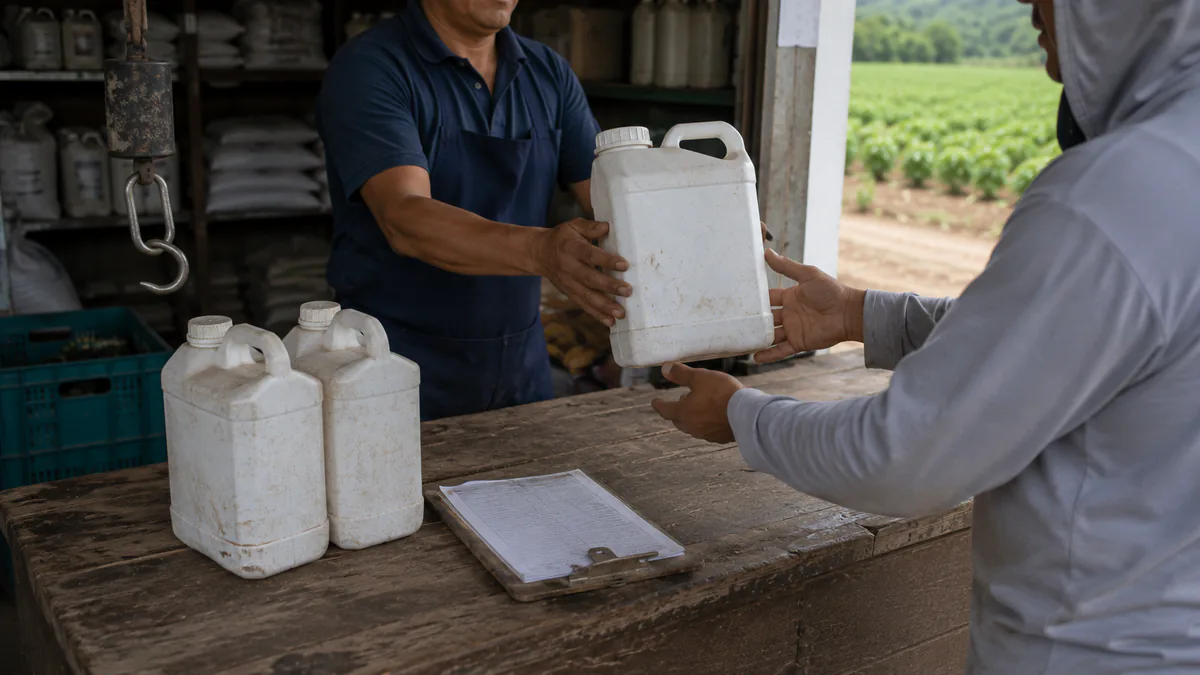
The most expensive hole in field-operations control is usually the warehouse. The rule that closes it: the warehouse issues only against a specific task, and the crew returns what it does not use, on the record. The request starts on the work order with quantities per field; the issue deducts stock against that order; at closing, the surplus comes back with a return entry. Real consumption per field equals what left the warehouse minus what came back. Without this cycle, inventory "reconciles" only on physical-count day, and input cost per field stays an estimate.
That same record serves more than one purpose. FAO's good agricultural practices manual for fruit and vegetable growers (2012), from its Regional Office for Latin America and the Caribbean, includes a sheet for logging every crop-protection application: the field, the date, the crop, the pest or disease, the product and its active ingredient, the dose, the equipment used and the operator responsible. A properly filled work order produces almost all of those fields with no extra work; that case is covered in detail in pesticide application records.
Record what happened, not what was planned
The plan says 12 workers and 40 liters; the field says 9 workers, 34 liters and one field the crew did not finish. Control exists only when that second version reaches the record:
| Resource | What the supervisor records in the field | What it enables at closing |
|---|---|---|
| Crew | Who attended, on which task and field, with their units when the task runs on piece rate | Labor cost per field and correct pay for the worker |
| Progress | Finished units per field | Knowing whether the task tracks the plan |
| Machinery | Hours per machine and per field | Machinery cost charged to the field that used it |
| Inputs | Real consumption per field after returns | Actual input cost instead of an estimate |
Record at the work point, the same day: Friday's memory averages what Monday knew exactly. The same Precision Agriculture review puts it bluntly: data quality drops when nobody records in real time, and a logbook that lives in the office ends up depending on the workers' memory and motivation.
From closed task to actual cost
Every completed order produces a composite cost: labor at employer cost, inputs at warehouse cost and valued machinery hours. If the order touched several fields, it splits the cost on an explicit basis, such as hours, progress or output. The FAO cost handbook frames the measurement ideal in the same terms: record the time each employee spends on each specific farm activity, then multiply it by the wage rate in their contract. That is what lets a farm allocate labor cost across its activities and crops.
The sum of the cycle's closed tasks is the field's operating production cost, before allocated overhead; the full costing method is in how to calculate production cost per field. The plan-versus-actual comparison, task by task, is what teaches: the big difference almost always sits in two or three activities, not spread across all of them.
How this works in Aragro
Aragro's work orders implement this cycle with a state machine: an order opens, may take a scheduled date, and moves to in progress when work starts. Starting triggers the inventory request to the warehouse; at closing it passes through a brief completing state until completed, and a supervisor can revert a completed order when something went in wrong. Each order carries its crew with attendance and progress per field, its machines with hours, and its inputs per cost center, with the request-and-return cycle built in: the order cannot complete while inputs remain unresolved. On completion, Aragro distributes the actual cost across the fields worked by hours, progress or harvested output into their cost centers; crew payments flow to pre-payroll.

Recording remains field discipline: Aragro structures and calculates, but it does not invent data for the task nobody entered. Feature availability, including progress tracking, piecework, planning and budgets, depends on the plan.
Pick a single activity next week and control it end to end with one work order, from plan to cost. If that record lives in a spreadsheet today, when it pays to switch to cloud software reviews the thresholds. See the product overview and plans and pricing for availability.
Frequently asked questions
What is an agricultural work order?
An agricultural work order is the document that authorizes and controls a field task: which activity, on which fields, on which dates, with which crew, machinery and inputs. At closing it records what the crew actually did and what it cost.
What should a work order include?
A work order should include the activity, the field or fields, dates, an owner, assigned workers, machinery, requested inputs with dose or quantity, and the progress units the crew will measure. Without those fields, nobody can cost the task afterwards.
How do you control inputs leaving for the field?
Inputs follow the request-use-return cycle: the warehouse issues only against a specific task, the supervisor records usage per field, and the crew returns whatever it does not apply. Issued minus returned is the real consumption.
How is a task's actual cost calculated?
A task's actual cost is the sum of what the order records at closing: the crew's day wages and piece rates, consumed inputs at warehouse cost, and machinery hours. That total goes to the field, or splits across the fields the crew worked.
Who should record the task: the supervisor or the office?
The supervisor who watched it happen should record it the same day. The office can review and approve, but a record rebuilt in the office days later loses the quantities, the fields and the per-worker units.
Can Aragro control field operations?
Yes: Aragro's work orders move through states (open, scheduled, in progress, completed), drive inventory requests and returns, record crew, machinery and progress per field, and on completion assign the actual cost to cost centers.